

How Park Corners Become Active Pump Track Zones
Many parks have corners of land which are often passed but not utilized. The space is next to a pathway, behind a playground, along a parking edge or down the middle of a strip of grass that the park department mows to save money and to look nice but add no value to the users of the park. These underused corners of park space are not leftover space. They are small space opportunities for the landscape architect to design a program for the underused park space corner.
A modular pump track for parks is a fun way to turn passive parks into active recreation areas for kids and adults on bikes, scooters, skateboards, BMX, inline skaters, and even balance bikes. As with any recreation feature, good design for landscape architects starts with site flow, safety, drainage, visibility, and uses for plantings, seating, and future park development.
Why Do Underused Park Corners Matter in Park Design?
A park corner that is not put to use to its full potential has no clear function. People walk by it, but there is no reason to stop for it. A bench is not enough. A small lawn strip is nice, but does not attract families, teenagers and children who love to cycle as much as this space does.
A pump track is a landscape suitable for park corner activation. It gives the space a function, provides a constant sound, generates repeat business and visual activity in the public domain. In the meantime a relatively small area of land is productively used – too small for a full sports field, too awkward for a typical playground.
Common underused park corner types include:
| Site condition | Pump track design opportunity |
| Edge of a playground | Adds active riding for older children |
| Near a shared path | Creates a wheeled sports stop without blocking walkers |
| Flat grass corner | Turns passive maintenance land into a recreation feature |
| Park entrance side area | Builds a strong first impression with visible activity |
| Beside a youth or community center | Supports after-school and weekend use |
A compact design of a pump track can function as a strong ‘node’ within a bigger park system and does not have to grow into a big attraction.
What Makes a Pump Track Suitable for Small Public Parks?
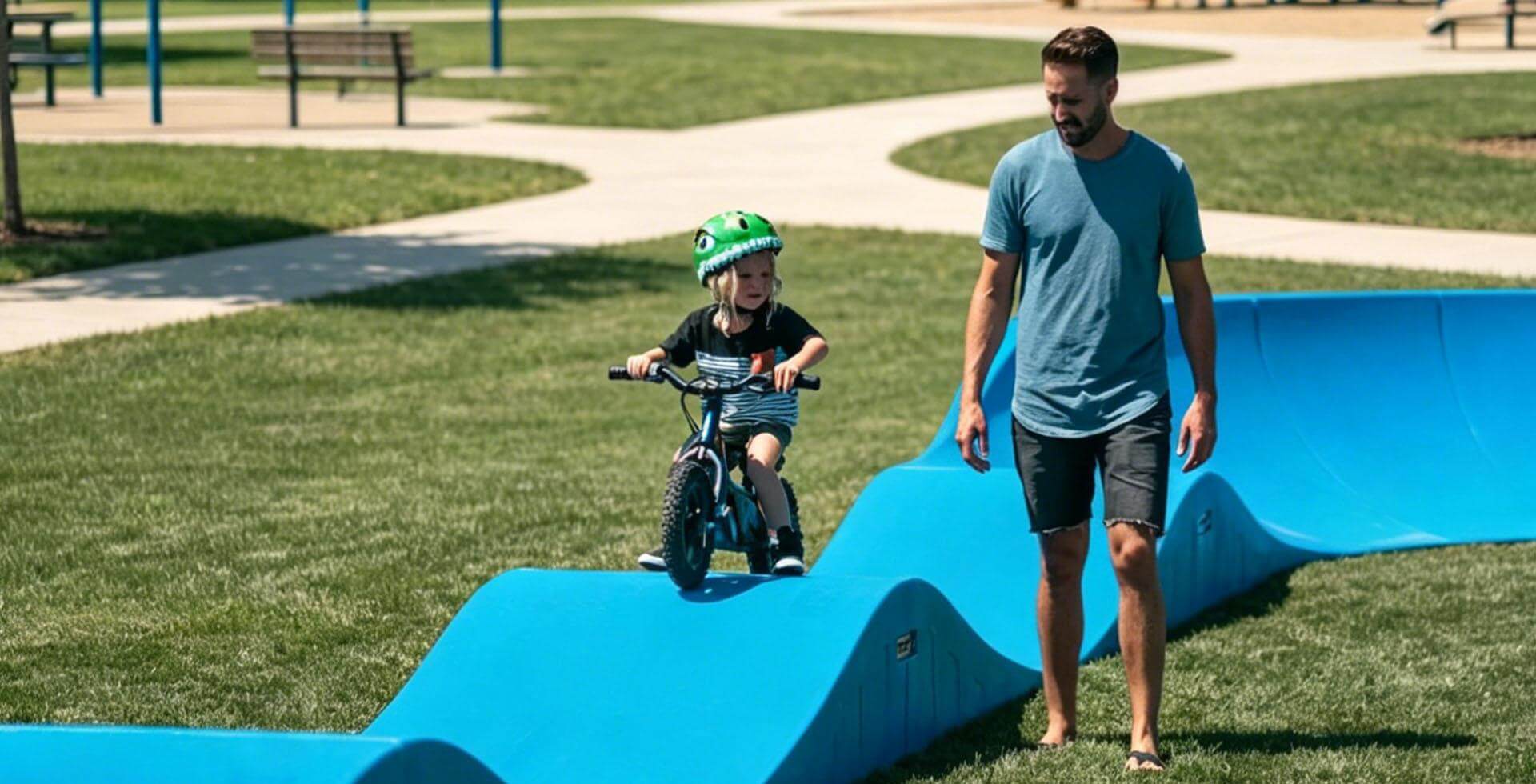
A pump track consists of rollers, berms, turns and a number of connected lines that are ridden in both directions. Rather than generating speed through pedaling, riders use their body weight to go faster and faster. A pump track is therefore very engaging, very skill-based and very repeatable. A child can ride a pump track slowly, a teenager can ride it fast and a parent can even watch from the side of the track and still get to feel part of it all.
For small public parks the value is in broad use. One wheeled sports zone can cater for many users rather than the area being taken up by one narrow user group. Bikes, scooters, skateboards, BMX bikes, inline skates and balance bikes are just a few of the many items that can be used in one outdoor recreation space if the layout and rules are planned properly.
A small pump track in a park has lots of repeat business too. Not just because it’s fun to ride but also because people get better each time they go for a ride. People practice to try and complete a turn better, try and find the best line and to try and ride in a straighter line over the rollers. No need for a big building, no need for paid staff and an operating model to match.
How Should Landscape Architects Evaluate the Site First?
Site planning for pump tracks should commence prior to establishing a layout. Even a seemingly insignificant corner can draw empty attention on paper but hold constant activity on site. In the morning a dog may cross that area. In the afternoon parents may gather there after school. By end of day maintenance vehicles will have created a shortcut through that corner.
Check Movement Flow and Access Points
Good pump track design for landscape architects means charting out every single movement around the corners of the track. Where do people walking along the landscape enter the track? Where do bikes arrive at the track? Where do people waiting to have a go at riding around the pump track sit? Where do very young children stop to regain confidence to continue to ride around the track.
The entry point should be clear and away from fast walking routes. The exit should lead riders back to a calm waiting zone, not straight into a playground path or picnic area. In a busy community park, even a 2 to 3 meter buffer between the track edge and the main pedestrian path can make the space feel more comfortable.
Review Visibility and Supervision
A community pump track must be visible for parents to be able to see their children playing, for park staff to be able to see into the area, and for other visitors to the park to feel that the area is part of the park and not that it has been taken over by a group who are using it as a private facility. It should not be hidden behind a dense area of planting, or placed in a corner of the park where visibility is a problem.
In addition to design, visibility can also support natural safety. A pump track positioned near seating, lighting, and normal activity path all feel more safe and welcoming than a track positioned far in the back of a park.
Study Drainage and Ground Conditions
Drainage is often the quiet detail that decides whether an outdoor wheeled sports facility works well. Low points, soft soil, poor runoff, and nearby irrigation can all create problems. A pump track zone needs a stable base and a plan for stormwater.
Studying how water moves after a rain fall and grading a park corner that is already collecting puddles, could be addressed by incorporating the design with a suitable base or directing water from the area to an adequate drainage route prior to installation.
How Can Modular Pump Tracks Fit Irregular Park Corners?
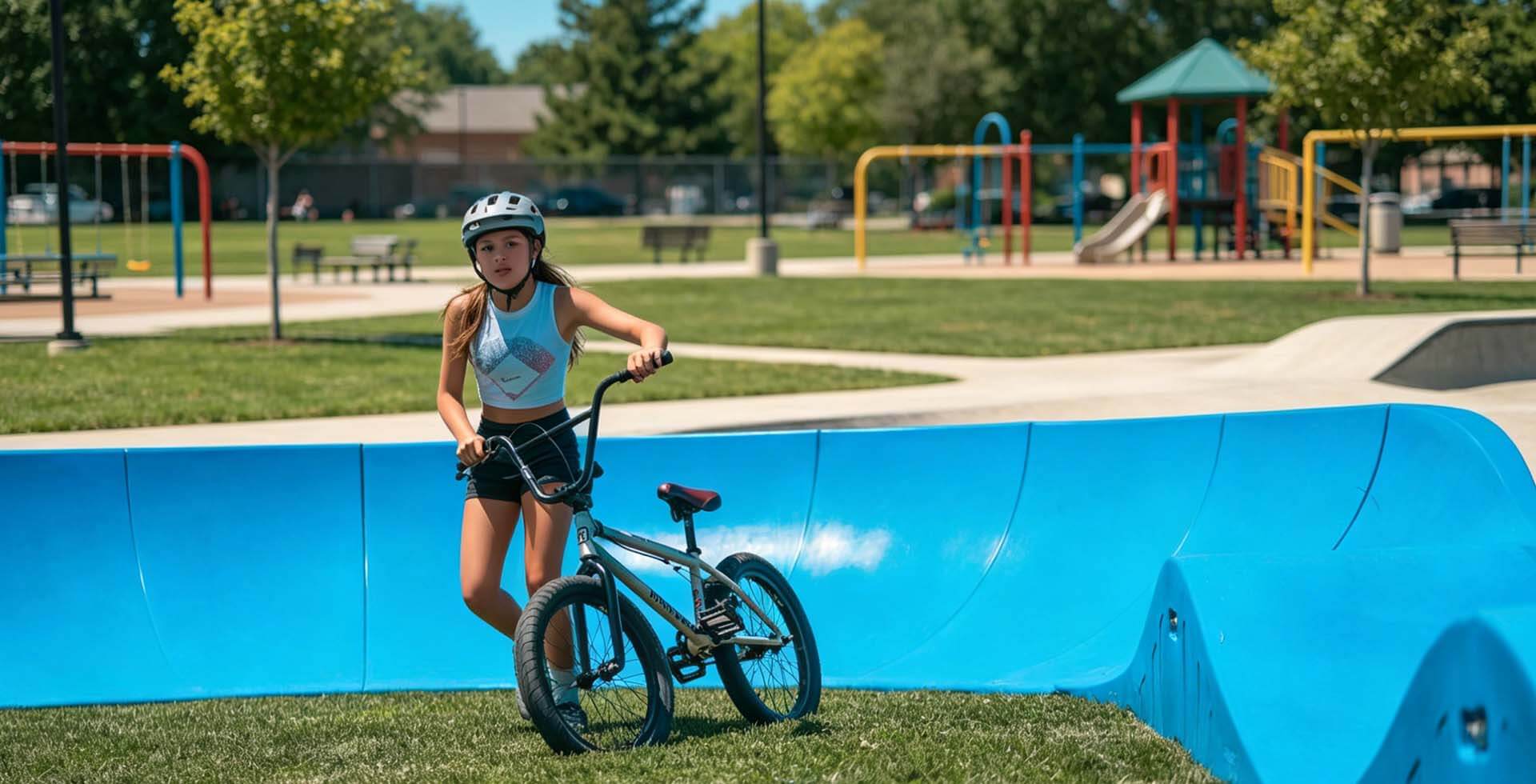
The corner of a real park is rarely a perfect rectangular block. It could contain established trees, utility covers, sloped edges, seating, fences and existing tracks and trails. Thus a modular pump track for parks can be very useful for park upgrades and for a phased recreation development project.
Unlike larger civil works projects that demand large amounts of space, a modular design is highly versatile and able to easily service tight or irregularly shaped areas. Further, as budget, market demand or site areas fluctuate, a modular design allows for rapid expansion or contraction as required. This makes a modular design for a City Park highly suitable for projects that are first launched on a small scale in order to gain support from local residents, as well as other designs that require to be flexible in order to be relocated during Park development work.
A modular pump track installation may suit:
- Small neighborhood parks with limited open space
- School-adjacent recreation areas
- Park corners beside walking and cycling paths
- Community centers with outdoor yards
- Campgrounds, resorts, and public leisure spaces
- Temporary activation zones before a permanent park upgrade
The equipment will still look intentional even when not in use. The track should link up with the paths, seating areas, shade and planting to make a feature of the area rather than looking like turf equipment had been temporarily left on the grass.
How Can Safety Stay Strong Without Making the Track Dull?
Safe pump track design for beginners doesn’t have to mean dull. Quality beginner-friendly pump track design includes considerations of flow, adequate space between features, good sightlines and grip. It allows complete newbies to ride at their own pace, yet also provides enough rhythm and challenge for regular riders to remain interested.
Separate Riding Lines from Walking Routes
We always want to make sure that the riding line is distinct from the main pedestrian path. For walkers, they need a safe and clear route around the pump track. For riders, they need a defined entry, clear direction of travel and a designated waiting area. This is particularly important when the pump track is close to a playground as there are likely to be younger children playing in an unpredictable manner.
Add Buffer Space Around Turns and Exits
To decrease conflict within the space, we want to add some extra breathing room to the turns, exits and waiting areas. A rider exiting a turn may drift off slightly, children may stop suddenly in front of you and scooter riders may step off the track at the edge of a turn. By incorporating a buffer within these areas, we can decrease conflict and keep the park feeling calm even when the track is busy.
Choose a Grippy, Anti-Slip Riding Surface
A good quality modular pump track is built with a grippy, anti-slip surface. This is particularly important for outdoor use where dust, rain and varying temperatures can greatly affect how a pump track rides. Great for kids, new riders and a mix of wheel sizes.
The surface under the tyres must be controllable. Riders need to feel and be able to create flow whilst having enough grip to not fall off. This is the core of a good family friendly pump track zone.
Plan Simple Rules and Waiting Areas
As few words as possible should be used to set out rules and guidance for riders. Include information about direction of travel, advice on wearing helmets, age groups and whether riders travel in one direction. Riders can be asked to wait in a small space near the start of the course until it is safe to begin cycling. This means that riders are kept organized and do not block the track.
What Landscape Elements Help the Pump Track Fit the Park?
A pump track can be a welcoming component of a larger landscape when it is integrated into the overall design. By incorporating planting, shade structures, seating areas and connection to paths, a landscape architect can work to make the area feel more human scaled and less industrial.
A good design would include a shaded viewing area for parents and a very soft buffer of low planting between that and the playground. A clear path to the playground and a bench line that faces the track and does not sit too close to very fast turns. We will keep as many of the existing trees as possible. Many of them are large enough to provide lots of shade during the hot summer months.
View corridors should not be obstructed by planting, using low growing shrubs and grasses and open tree forms. In many parks and spaces the most dynamic result is to add energy to the site whilst keeping it open, green and readable, such as with a pump track.
How Can Pump Tracks Improve Community Use and Park Value?
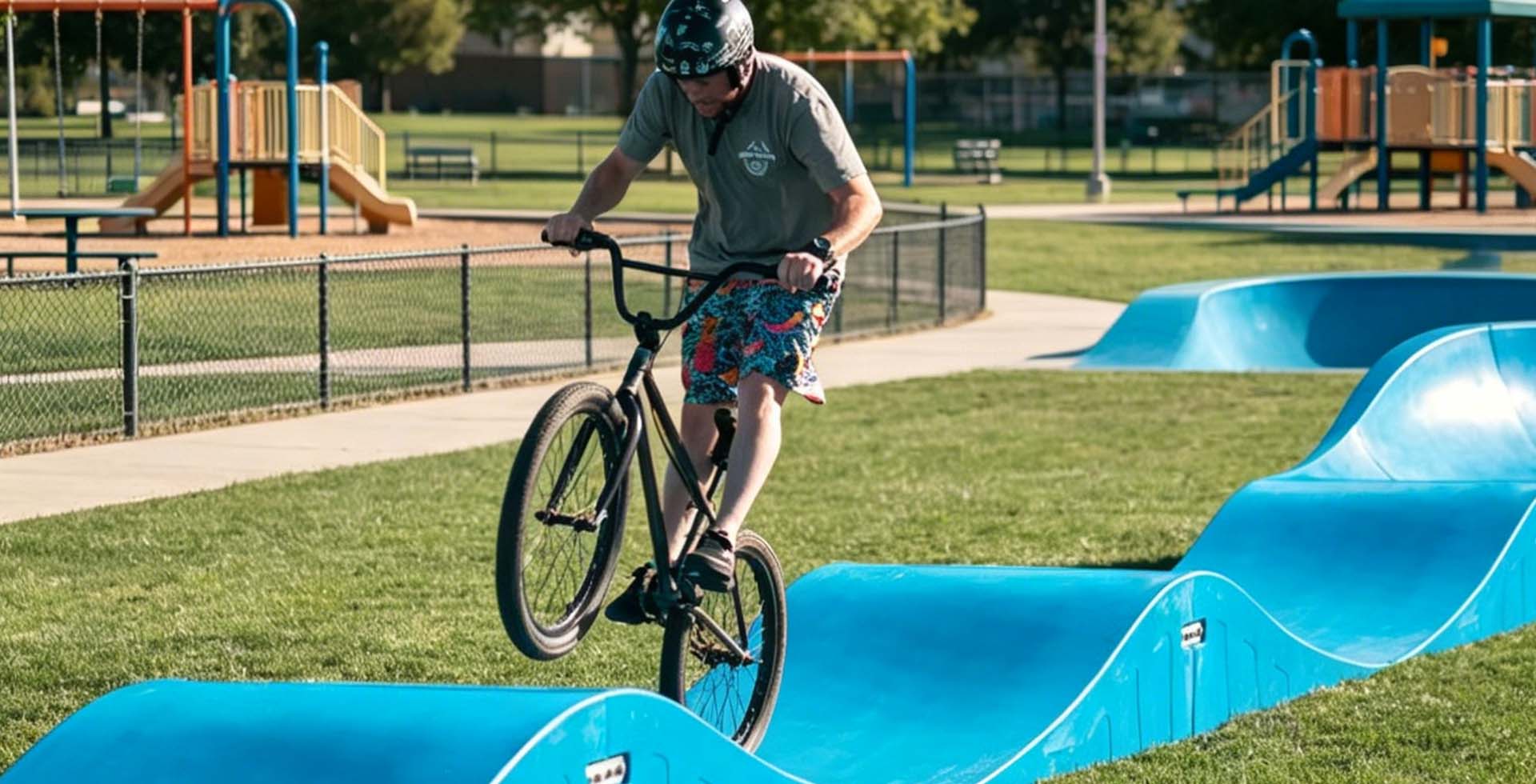
Community pump tracks can transform the way we experience a park on a daily basis. Prior to construction, a neglected corner of a park would consist of a never ending cycle of lawn mowing, and occasional walkers jay walking through the space. After design and installation, a once neglected corner becomes the hub of a family friendly space, where kids can hone their biking skills, and scooters are welcomed in the space preventing them from riding on neighboring sidewalks and plaza’s.
The benefits are practical:
| Community need | Pump track contribution |
| More youth activity | Gives children and teens a repeat-use outdoor challenge |
| Safer wheeled play | Keeps bikes and scooters in a planned zone |
| Longer park visits | Gives families another reason to stay |
| Better use of small land | Turns a passive corner into active recreation |
| More inclusive play | Supports different ages, skill levels, and wheel types |
Active recreation zones are becoming more valuable as part of park planning for several reasons. While filling space is one reason, the real value of such zones is that they create habits for daily use.
Why Is a Modular Pump Track a Smart Low-Maintenance Park Amenity?
Many park departments consider more than the initial cost of a park feature. They must also consider how the feature will hold up over time, how much maintenance it will require, how much wear and tear it will put on staff, and how easily it can be modified in the future. Thus, a low-maintenance park amenity is one that will continue to be useful over time as it is used repeatedly by the public without requiring heavy repairs each season.
Dirt courses can shift form after a heavy rain and with excessive use. Wooden structures can become hazardous when wet. Concrete and asphalt are durable yet typically require more involved construction planning. They are also generally very difficult to move once they have been put in place. For landscape architects, building a modular pump track for parks is another option: a tough, outdoor structure that can be installed, modified, enlarged or moved as needed.
Modular solutions can be also be very suitable for park corner activation in case of a small site or when the project team first wants to test the demand for a facility before making a large investment.
Who Is ULTRAPUMPTRACK as a Modular Pump Tracks Supplier?
ULTRAPUMPTRACK is a provider of modular Pump Tracks for the creation of outdoor wheeled sports spaces for park districts, schools, community centers, camps, resorts, backyards and commercial recreation facilities. ULTRAPUMPTRACK is also able to design a customized track layout in the given area where it will be installed. Unlike purchasing a track and then trying to find a location in your park for it to sit, designing the track to fit within the underutilized park corner will result in the space becoming a fun, safe and active area for children to play within.
Our modular pump track designs offer variable dimensions to create an outdoor recreation space that is flexible, durable, easy to assemble and is accessible by a variety of users. The pump tracks we design are suitable for a variety of wheeled sports users including; mountain bikers, kids on bikes, scooters, BMX riders, skateboarders and inline skaters. For the landscape architect, city planner, developer and park owner our designs are easily matched to site constraints, budget, user requirements and future development plans.
Conclusion
Park space is valuable and underused park space is a wasted opportunity. Redesigning underused park space into a safe, functional and sustainable active space such as a pump track with strong community value is possible through thoughtful design of site flow, access, drainage, seating, shade and plant selection by a landscape architect.
A modular pump track for parks is a product that functions well within a number of criteria points for parks and recreation including functionality in very small spaces and the ability to service many users of wheeled sports. The very best projects don’t view the Pump Track as a stand alone product – instead they use the product as a framework as how the park can function on a daily basis. For instance a park can function to teach children balance skills, provide teenagers with exercise opportunity, allow families to spend quality time together and even to highlight an ‘out of mind – out of sight’ area of park to increase use.
FAQs
What is the best way to turn an underused park corner into an active recreation zone?
Give the corner a function, connect it to other paths in the park and maintain sightlines. Select a small activity and make it compact to fit into the available space. A modular pump track for parks is a great option because it creates movement, brings return visits and draws mixed age groups playing outdoor games in the space.
Is a modular pump track suitable for small public parks?
Yes. Modular pump tracks are suitable for small public spaces if they are designed with the available space, the age of users, access points and safety buffers in mind. Small pump tracks can be designed to fit into long thin edge spaces, into corners of existing playgrounds or into small community park space for upgrades.
What should landscape architects check before pump track installation?
When designing a pump track it is always best to consult with a landscape architect to assess key park attributes such as site dimensions, user flow, key pedestrian paths and access points for entry and exit, surface drainage, ground stability, visibility, shade, seating, maintenance access and future development potential. By assessing these key park attributes a well designed pump track can become a natural part of the park as opposed to an after thought.


