

Best Location for a Holiday Park Pump Track
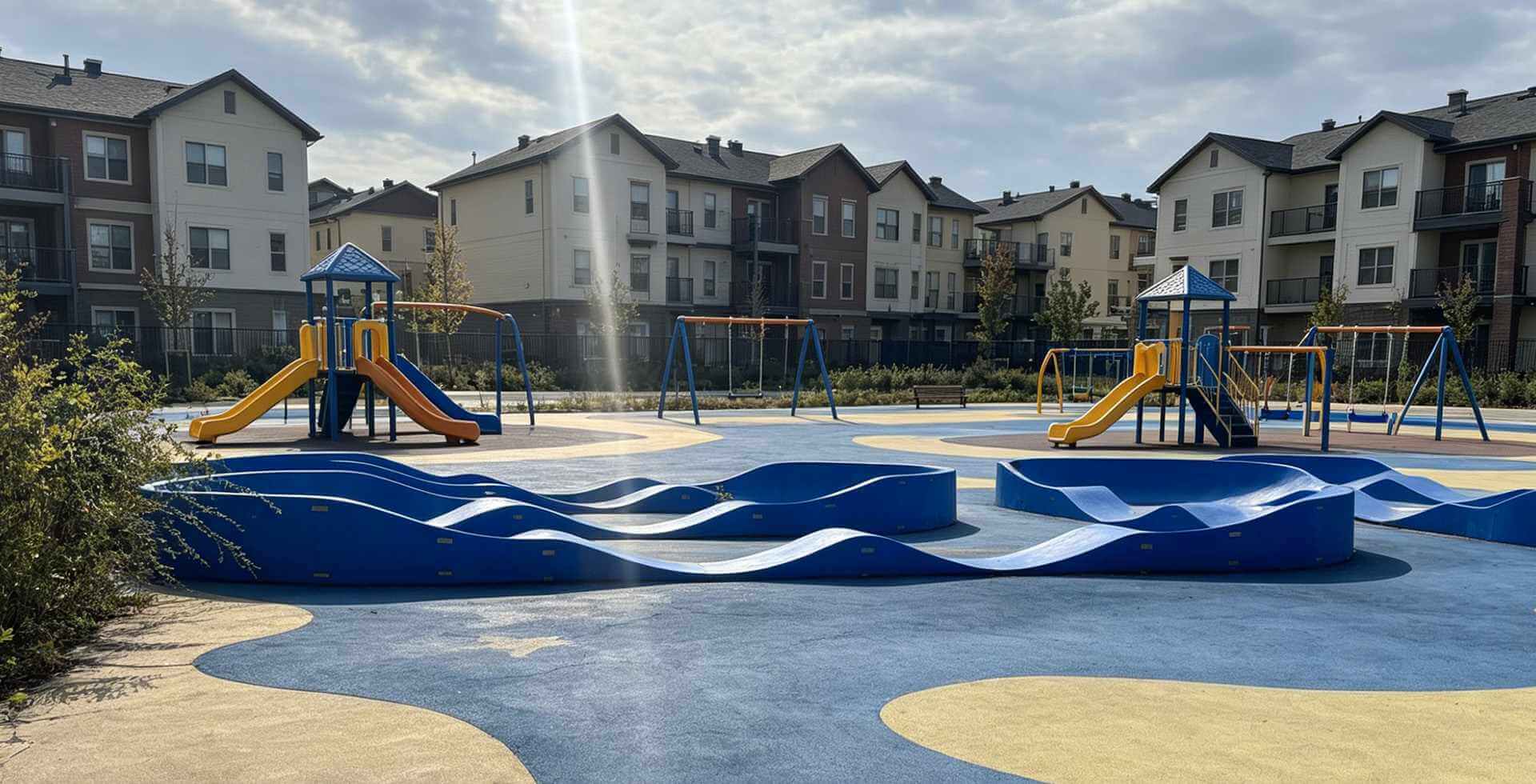
The new residential developments of today are no longer simply judged by floor plans, orientations, and the amount of parking and landscaping that one receives. Most importantly, the ‘outdoor space between buildings’ is scrutinized in great detail. In particular, parents want to know where their children can play after school. Teenagers on the other hand, generally want more than a bench and some grass to play on. They require more than just ‘outdoor space’ and want to be offered more amenities that will bring life to a community. These are the items that need to be provided in order to complete a development as opposed to merely ticking boxes.
When considering playgrounds for new housing projects, the debate between a pump track and a traditional playground has become a very practical one. A traditional playground is familiar to most parents and clearly conveys to younger children that they will have lots of fun on the playground. A pump track conveys a different message of movement and fun for life, which can be used repeatedly by kids on bikes, scooters, skateboards and even balance bikes as well as other wheeled sports, all in one compact outdoor play space.
Better for developers, landscape architects and community planners to decide whether a lawn is appropriate for their target residents, available space and required maintenance, and for the image that they are trying to project.
What Does a Traditional Playground Bring to a Residential Project?
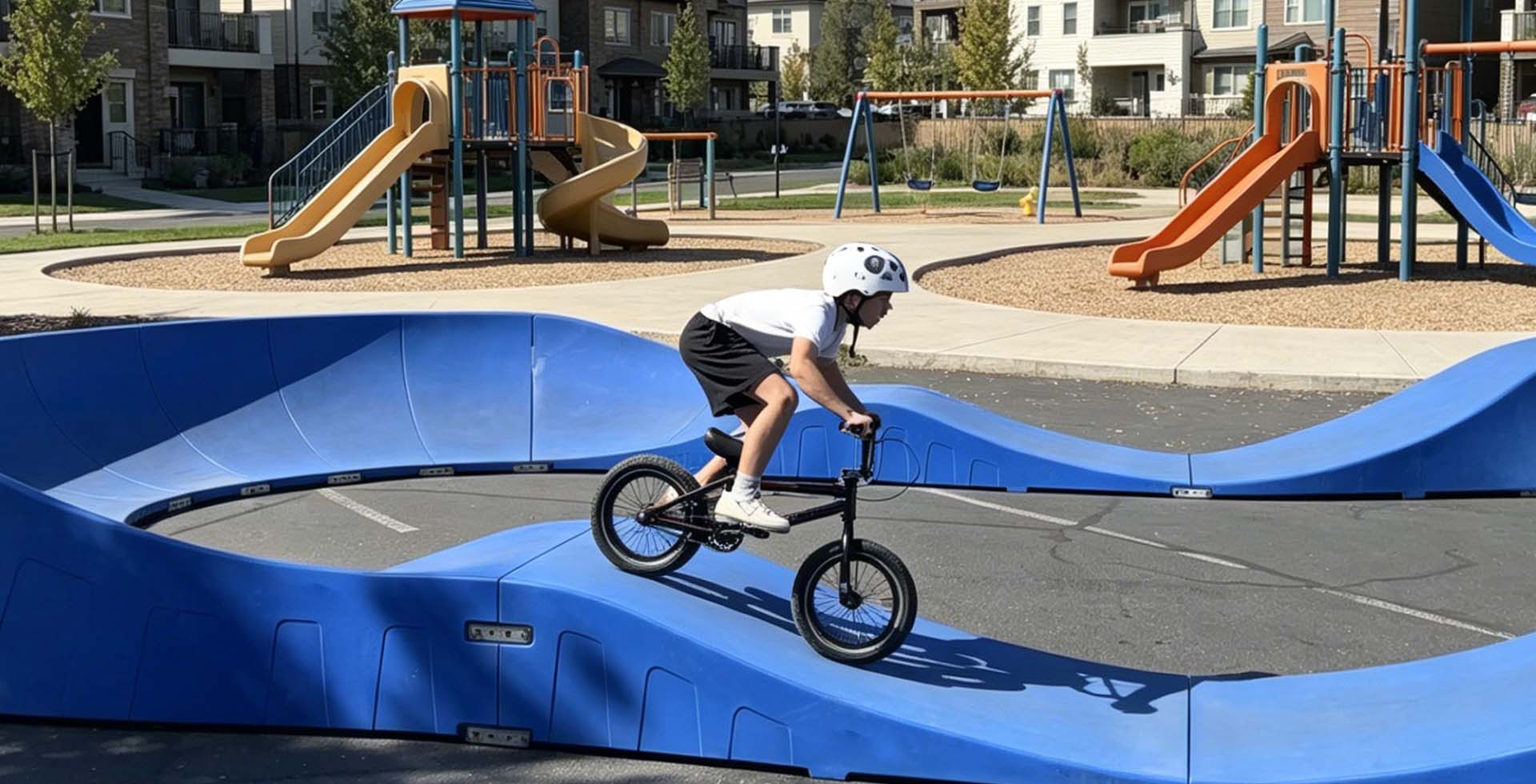 A traditional playground is one of the safest options for family focused housing. It tells parents that their kids have a place to play in a more traditional way and get exercise by climbing, sliding and swinging etc and make friends with other kids and neighbors from the development.
Where Traditional Playgrounds Work Best
Traditional playgrounds perform best in communities with young families with toddlers and pre-schoolers. A small area of the courtyard can be dedicated as a ‘slide zone’, swing area, climbing frame area and covered soft surface area and become a daily destination for families.
Apartment communities, townhouse projects and suburban residential developments can benefit from these types of play equipment for children.
| Factor | Traditional Playground Value |
| Main users | Toddlers and young children |
| Parent appeal | Very easy to recognize |
| Activity style | Climbing, sliding, swinging, pretend play |
| Sales message | Family-friendly living |
| Best location | Courtyard, pocket park, daycare zone, shaded lawn edge |
However, traditional playgrounds are generally developed for the under 8’s, then the kids move on to using scooters, bikes and skateboards and they use the sidewalks, parking areas, ramps and other informal locations within the park to complete tricks etc. These areas can often be dangerous and the playground does not provide long term value to this user group.
What Is a Pump Track in a Residential Community?
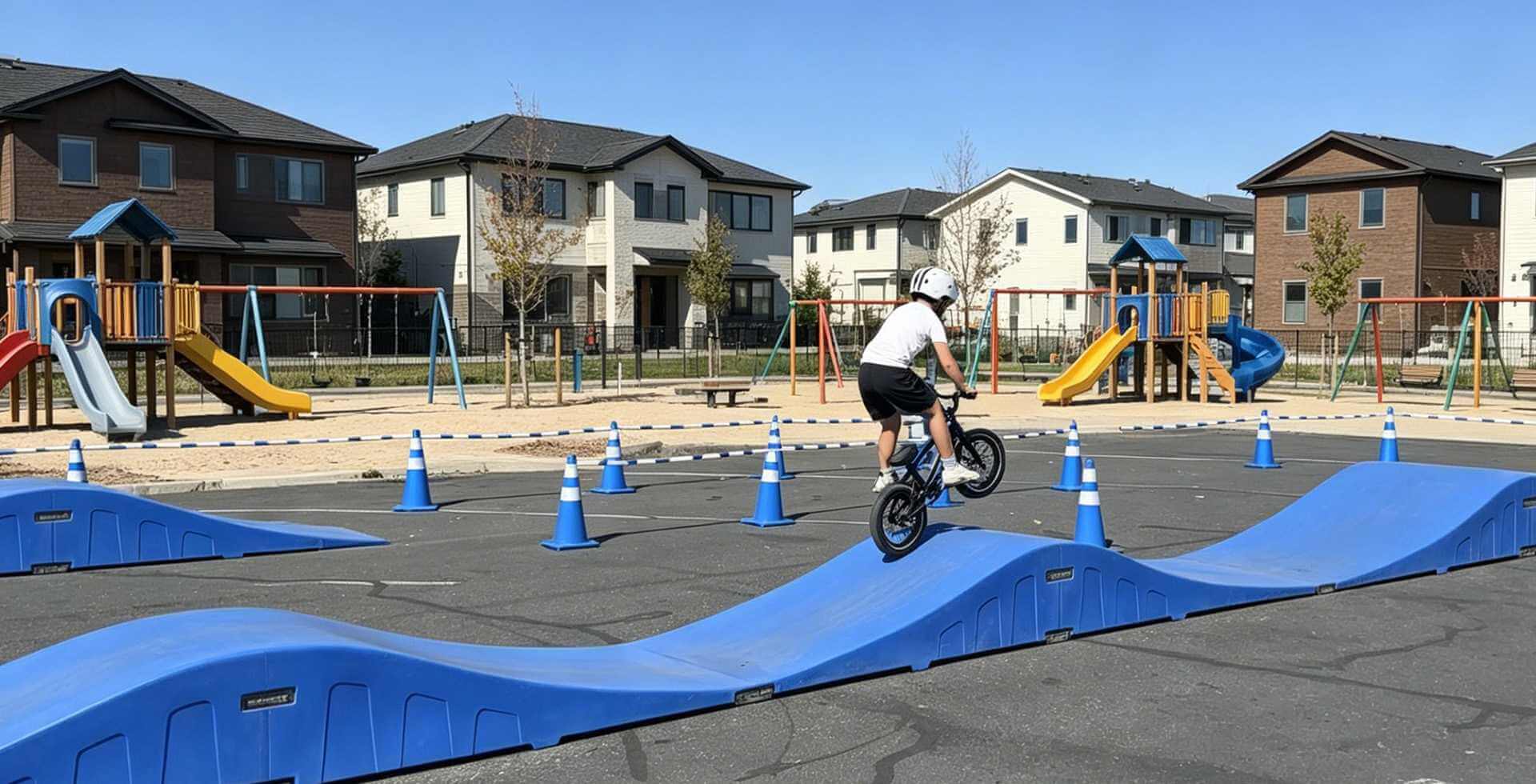
A pump track is a specially designed cycling circuit made from rollers, berms, turns and features. Users can complete a circuit in a continuous motion using natural body position to gain speed, as opposed to repetitive pedaling or pushing. At first glance, using a pump track may seem quite straightforward but brings immense repetition and challenge to riders, who constantly strive to improve every lap.
Why It Feels Different from a Playground
Most people think of a residential pump track as a bike lane or even as a skatepark. The reality is that a modular pump track is somewhere between active play, outdoor fitness and community recreation. The best place for children of all ages to start is on balance bikes. For the older kids there are always scooters, for the teenagers skateboards and BMX bikes are very popular. And of course there are always the parents who sit on the seating edge to watch their children or join in on the fun of riding around the track themselves if it is a beginner track.
One amenity can support all the age groups in a new residential development. Rather than children quickly growing out of a play space a pump track will remain relevant as they get older.
First, the surface needs to be accurately described. An outdoor pump track riding surface for residential use is not smooth or slippery. Instead it is an anti-slip surface, which is weather resistant and allows riders to have grip on the surface to complete turns and pump transitions.
Pump Track vs Traditional Playground: Which Performs Better?
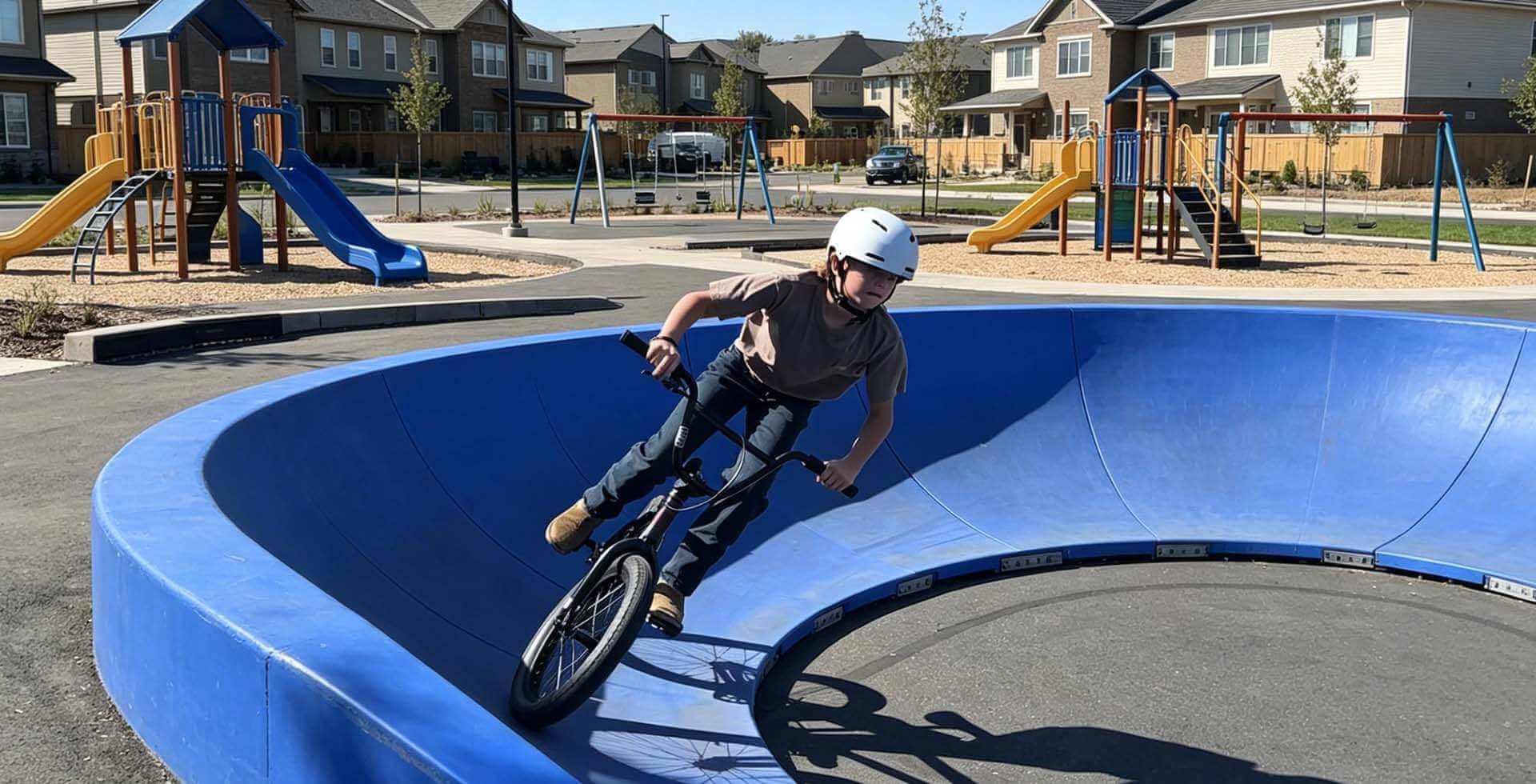 The strongest articles comparing playgrounds, pump tracks and residential amenities are those that also compare key practical issues that are of relevance, such as who will use them, how frequently they will be used, how they will add value to the community and how difficult they will be to maintain. A simple list of features is not enough.
Direct Comparison for Developers
| Planning Question | Pump Track | Traditional Playground |
| Who uses it most? | Children, teens, families, wheeled-sport users | Mainly toddlers and young children |
| Does it support repeat use? | High, because riders improve lap by lap | Medium, depending on equipment variety |
| Is it visually distinctive? | Strong, especially for marketing images | Familiar, but often expected |
| Does it fit small sites? | Yes, with modular compact layouts | Yes, but safety zones are needed |
| Is it easy to expand later? | Often easier with modular systems | Usually harder after installation |
| What lifestyle does it sell? | Active, modern, outdoor, social | Safe, family-friendly, child-focused |
Choosing a pump track over a traditional playground is not just about play. The choice reveals the kind of community a project wishes to present. A traditional playground heralds a project as suitable for families, whereas a pump track presents a space for families, children and teenagers to move through, to meet up in and to spend time in collectively while outdoors.
Which Amenity Uses Space Better?
Land in new residential developments is very expensive. Every square meter has to generate value. The higher density of apartment developments as well as of mixed-use developments places a particularly high burden of performance on the land.
Compact Layouts Can Change the Decision
A traditional playground has to consider space for play equipment, a fall zone, a pathway through the play space and seating. While such a play space can be very effective, the layout can often become ‘fixed’ once equipment has been installed. In contrast a pump track can be laid out in a continuous loop or in a series of connected turns to create a rhythm to the design. This type of play space can be set in a lawn, in a small pocket park, in the middle of an activity space, or next to a clubhouse.
The benefit of a modular pump track design is that it can fit into most unusual shaped sites. Long, thin strips of grass next to sports courts, rectangular grass areas next to community centers, and large corners in landscaping designs can all be transformed into fun features for riders to practice their skills. A pump track within a large housing development could also form part of a larger outdoor recreation space that includes seating, shade, planters and linear seating with a walking path through the space.
A number of these allow a developer with a phased construction plan to open up a riding area of initial size, and then progressively add more modules or expand the area as demand increases or as subsequent housing phases are opened.
Which Amenity Creates More Daily Use?
This playground might be busy after school and on weekends because there are a lot of young families in the area but once children get older they don’t use playgrounds as much. A pump track has a broader age range of users.
Why Repeat Use Matters
No one judges an amenity on opening day. People judge an amenity after six months and whether or not anyone uses it. A pump track has built-in replay value. Riders return to the track time and time again trying to improve certain aspects of their riding such as clearing a particular turn better, going faster through the rollers and features and even trying to ride the whole thing without putting a foot down on the ground. So a pump track is more of a skill zone as opposed to a one off play feature.
Real residential scenes make this easy to picture:
- A 5-year-old rides a balance bike on a small loop while a parent watches from a bench.
- A 9-year-old practices scooter control after school instead of riding through the parking lane.
- Teenagers use the track as a safe meeting point instead of gathering near building entrances.
- Families visit the outdoor play area together because different ages can do different things nearby.
The daily comings and goings bring a new residential development to life. Unlike empty amenity spaces depicted in glossy renders, busy amenity spaces create real community feeling and are successful.
How Do Safety Needs Compare?
Both options require serious safety planning. A traditional playground requires suitable fall surfacing, equipment of appropriate age, shade, sightlines and a safe distance from roads and car park surfaces. A pump track requires clear riding direction, safe entry and exit points, rider signage, helmet reminders and sufficient space between riders and pedestrians.
Design Details That Matter
When it comes to a residential pump track, the intention behind the track design is not to make it as crazy as possible. Instead, it is better to build a flow that consists of a sequence of turns that are clear to see and to follow. This flow has to be on top of a surface with enough grip, so that in the turns and especially in the berms and rollers with as much side contact as possible with the anti-slip modular riding surface, sufficient control can be exerted. Especially for children and for new mountain bikers this surface quality is of major importance.
When designing a racing game, developers should think about the rest of the map as well as the actual racing line. Here are some examples of what a good setup for a section of track might look like:
- Seating for parents and grandparents
- Shade structures or nearby trees
- Clear signs for riding direction
- A small rest area outside the riding line
- Bike and scooter parking
- Lighting where evening use is expected
- A buffer from roads, entrances, and car traffic
A pump track is best considered as a community focused recreation space designed within a specific area as opposed to simply being an object that is to be placed on available land.
What About Maintenance and Long-Term Flexibility?
The maintenance of an amenity over the first year is crucial to whether it remains appealing to children and parents alike. A traditional playground requires periodic checks of various parts such as bolts, of the surfacing, of worn parts on equipment, of swing seats, of ropes, of coatings, and of loose materials. Dirt or timber riding features on a playground may change in shape or become slippery as they are subjected to the weather.
Modular Pump Tracks Help with Future Changes
A modular pump track is flexible for the developer as sections can be changed, adapted, extended or even moved. This makes it ideal for developments which are released in phases as well as for changes in user groups over time.
A hard-wearing, weather-resistant, anti-slip floor covering reduces the maintenance burden on property managers, since while the running track will still need to be inspected and cleaned regularly, it is not subject to the same level of need for reshaping as a dirt running track. Thus for a residential facility the surface can be easily managed within a budget and the facility will look good on a day to day basis.
When Is a Pump Track the Smarter Choice?
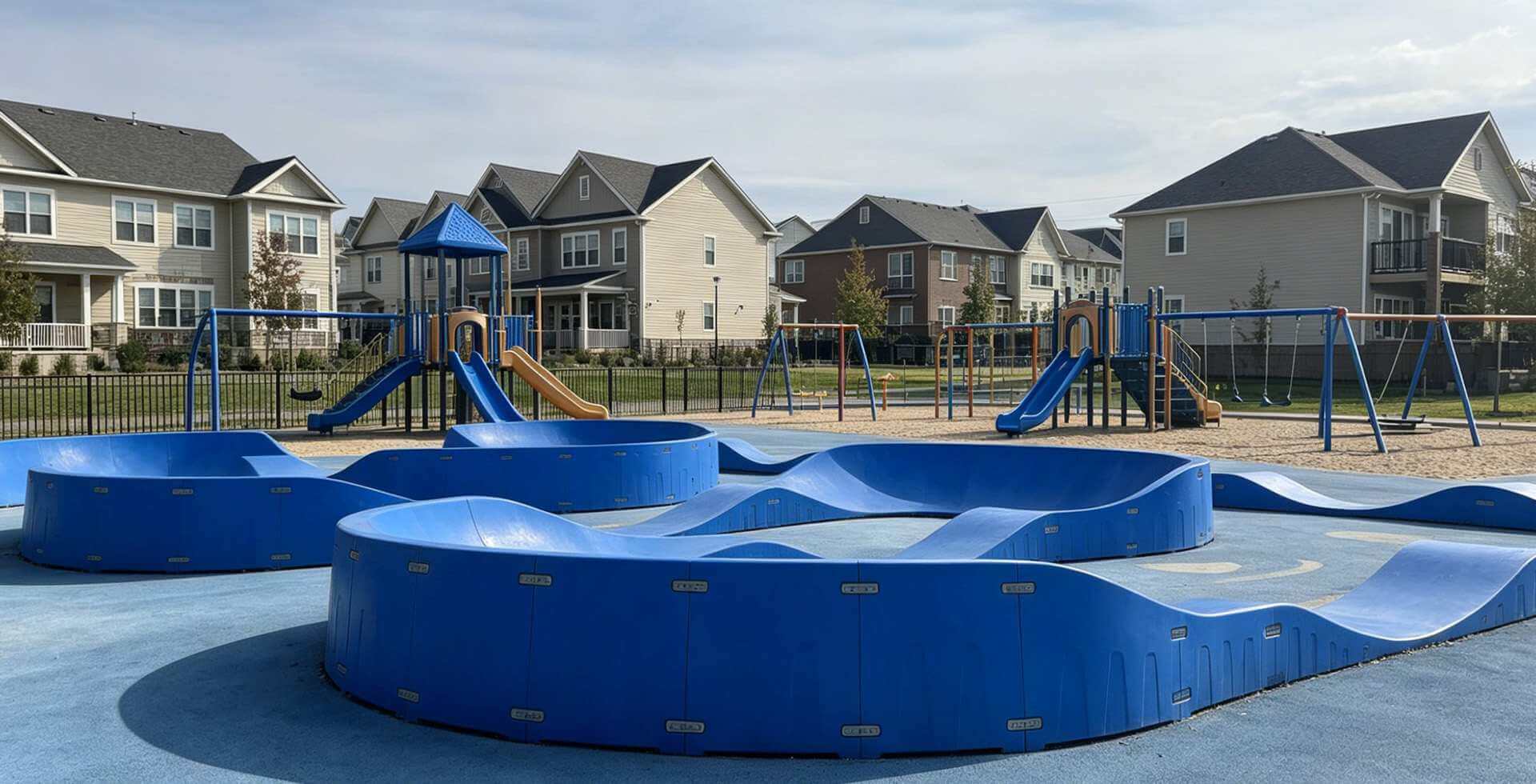 A pump track becomes the more desirable option when broad age groups, a high activity value and an memorable outdoor offer are the aim of a project.
Good Situations for a Pump Track
A modular pump track is a smart fit when:
- The development wants a modern active lifestyle image.
- Children, teens, and families all need outdoor recreation.
- The site has limited space but needs a high-use feature.
- The developer wants a playground alternative with stronger visual impact.
- The amenity plan may grow in later phases.
- The community wants to reduce informal riding in driveways, sidewalks, or parking areas.
For many residential play spaces, the pump track does not completely fulfill all the needs of play. Rather it fills the ‘gap’ between a playground for toddlers and a full sports court.
Is the Best Answer Both?
For large new residential developments, a plan that incorporates both elements of a playground and a pump track will likely be the most effective. For example, a small area could be designed for the 2 and under age group, and the modular pump track could be utilized for the 6 and up age group as well as for older kids, scooter users, bike users and teens. Add seating, shade, plantings and lawn and you have created a full outdoor family amenity as opposed to a single use play area.
A Better Outdoor Play Zone
A balanced residential recreation area might include:
- A toddler playground near seating
- A modular pump track with an anti-slip riding surface
- A shaded viewing zone for parents
- A small open lawn for flexible play
- A walking path around the activity area
- Clear separation from traffic and parking
By establishing different play areas that cater to different age groups at the same time an attractive development is created with a strong message: safe play for toddlers, exercise for the pre- and primary school children and a meeting point for the community as a whole.
ULTRAPUMPTRACK as a Modular Pump Track Supplier
ULTRAPUMPTRACK offers high-quality modular pump track systems for modern outdoor recreation spaces. As experienced dirt and asphalt track builders we also offer a lot of knowledge about riding on such a track. But the real heart of our work is the modular system that allows for a variety of different track configurations. The system is easy to assemble and it is very durable for long time outdoor use.
For residential developers, landscape architects, community planners, and recreation project owners modular pump tracks are an important component in their day to day work. Because most sites are not square or rectangular in shape and are delivered in phased increments, the supplier of modular pump tracks needs to be able to assist with the planning of the layout and with color options as well as assist with delivery, installation and future expansion of the pump track.
Conclusion
So, which of these amenities is best for new residential developments – a pump track or a traditional playground? The answer to this question is dependent on your project goals.
The traditional playground is still one of the best options for toddlers and young families, because it’s familiar to everyone, easy to describe and will be of use to almost every family housed in your project. But the modular pump track is a great way to get a age range in, get frequent use, good marketing shots and the flexibility to change it up in the future.
A pump track can be a very modern residential amenity that is active, social and memorable for developers and their customers. Hybrid outdoor play areas could also be considered as being better than a simple playground for larger communities. A hybrid area could consist of a small playground that is complemented by a modular pump track, seats, shades and space. In this way the areas of land are used more effectively than to fill a hole, providing a real draw to get residents active, to meet up with their neighbors and to return to the area time and again.
FAQs
Is a pump track better than a traditional playground for residential developments?
A pump track is better suited for the active outdoor recreation play of children, teens and families whereas a traditional playground is better suited for the play of toddlers. Both can be suitable for larger residential developments however.
Can young children use a residential pump track?
Is your child ready to use 2 wheels instead of 3? Our track is beginner friendly and young children can start off on balance bikes or scooters with riding direction, helmets and adult supervision. Our track has an anti-slip surface and good space around entries and exits.
Does a pump track need more space than a playground?
No. Modular pump tracks can fit in super small spaces but a playground needs buffer zones around all play equipment. This really depends on the space, the intended user and what else you’re going to build in the outdoors to create an amenities package.
What is the best amenity for a family-friendly housing project?
A basic playground for toddler play and a modular pump track for a more active and memorable community recreation space. This is a great family-friendly plan combining the best of both worlds.


