

Before Adding a Pump Track to a Public Park: A Planning Checklist for Local Governments
Councils approve pump tracks for reasons that have nothing to do with pump tracks. A grant deadline. A playground that failed its inspection. A councillor who rode one in another town and came back enthusiastic.
Then the thing gets installed, and the real questions start. Drainage. Who inspects it. What happens when a berm cracks in year four. What follows is the list we end up walking parks departments through anyway, and the items worth settling before a purchase order exists.
Some context on where the advice comes from. We have built tracks since 2014 – dirt and asphalt at first, molded modules from 2015 – and shipped them into parks, resorts, and sports facilities on four continents.
What You Are Actually Buying
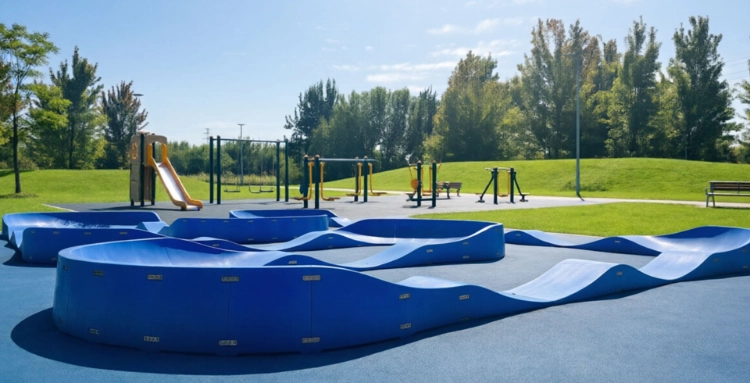
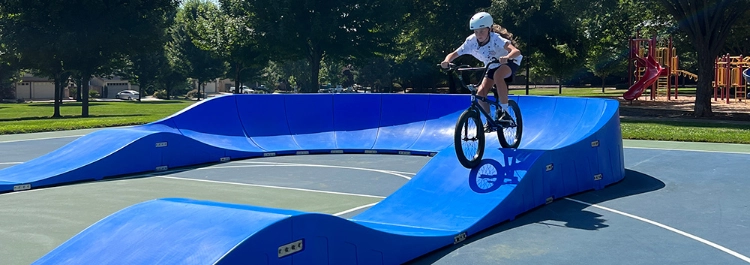
Worth being precise about what a pump track is: a closed loop with rollers and banked turns. Riders do not pedal. They push down the back of a roller, unweight at the top, and momentum carries the lap.
The earliest tracks were dirt, laid out for BMX and mountain bike racing on hard subsoil. Surfaces changed. So did the crowd. Skateboards, scooters, and balance bikes use the same loop now, which matters for how the brief gets written. Not a cycling facility. A wheeled-sports facility.
1. Write the Brief for the Riders Who Show Up
Every brief we receive says bikes. Then the first Saturday happens and half the kids are on scooters.
One footprint covers bicyclists, scooters, BMX, skateboards, inline skates. Balance is the entry requirement. Nothing else.
Worth putting in the grant file, plainly: a pump track carries almost none of the social gate a skatepark carries. No bowl to drop into. No regulars deciding who belongs. Kids roll at walking pace while a parent walks beside them. That is a participation argument, and it holds up better in committee than “youth facility”.
2. Walk the Ground With Public Works
Ask about drainage before anything else, because water pooling under a surface comes back as a repair bill two winters later. Then find the bench. If a parent cannot see the loop from where they already sit, the track will not get used the way the application promised.
Slope is the least of it. Modular units forgive more of it than concrete does, and they sit on awkward parcels – a park corner, a schoolyard, the dead space behind a community center – without reshaping the site.
Concrete does not forgive. Pour it and the footprint is fixed for thirty years, and the excavation crew arrives with it.
3. Compare How Each Material Fails
Dirt is the world’s default surface and the cheapest to build. It also erodes. Traffic and weather reshape it, one hard rain can take out a berm, and the repair line never closes.
Wood solved the shaping problem and created a water problem. A wet wooden surface is slippery, which is the sort of detail that ends up in an incident report.
Concrete and asphalt hold shape for decades. They also cost the most, and they never move. Molded plastic behaves differently: LLDPE cast in a mold with anti-UV and anti-aging agents, no coating to renew, no deformation to chase. The riding surface is anti-skid and stays anti-skid when wet.
4. Ask Planning Before You Ask for Quotes
A poured track is a construction project. Drawings, reviews, public comment, a calendar nobody can compress. Modules are a different category of object – assembled from manufactured parts rather than built in place – and they often need no planning permission at all.
Get that answer in writing during week one. It is the difference between opening this season and opening after the next election.
5. Phase the Purchase
Six basic modules make up the range. Eighteen base configurations are already drawn, and the layout can be revised after installation while the footprint extends whenever the money appears.
Open with a starter loop this budget cycle, add on the next one. Two openings, one supplier, and a track that grows alongside its riders instead of sitting half empty because the full build got priced out.
Cost, for planning purposes: plastic modular systems from Asian manufacturers land near two-thirds of comparable European product, shipping included.
6. Ask What Year Four Looks Like
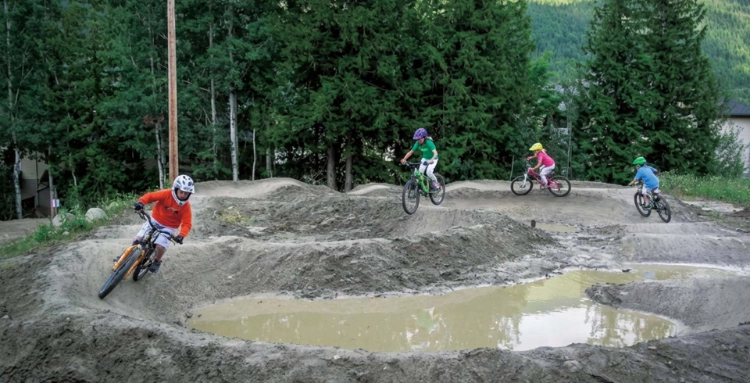
Dirt needs work after weather. That is a permanent line item, and it is the reason some parks quietly stop maintaining and eventually fence the thing off.
Installed properly, a modular track asks for very little. Hard-wearing composite, weatherproof, no deformation, nothing to recoat. Eight to ten years of normal traffic, with a 5-year product warranty behind it.
Coastal sites should read one clause early: inside roughly 500 yards (457 meters) of saltwater shoreline the warranty drops to two and a half years, because salt air counts as normal wear.
7. Check the Builder’s History, Then the Customer List
img.Modular pump track installation demonstrating versatile wheeled-sports use in public recreational facilities.webp
Ask what they built before modules existed. This company started as a mountain-bike downhill club in 2012, moved into dirt and asphalt tracks in 2014, launched first-generation modular plastic in 2015, and shipped the third-generation ULTRA PUMP TRACK into export markets from 2025. Utility model and appearance patents cover the system.
Then look at where the tracks ended up. An RV resort on British Columbia’s Elk River carries one. So does Sai Sha GO PARK in Hong Kong, 1.3 million square feet of sport. In Antwerp a skatepark operator rents his modules out for events. In Saudi Arabia the track logs 300-plus riders a week at 50°C.
Send the Site Plan
Send the site plan and a budget range and you get a layout sized to both, a price, and a straight read on the permitting question.
FAQ
Does a modular pump track need planning permission?
Usually not. It arrives as assembled modules rather than site construction, and most jurisdictions treat those two things very differently. Confirm it locally and keep the reply.
What is the lifespan?
Eight to ten years of normal traffic. Warranty runs five years from purchase, rainy regions included.
How much maintenance?
Very little. Nothing to reshape after rain, nothing to recoat as it ages.
How long from order to opening?
Production takes 7-10 days after the deposit. Freight runs 20-25 days to Australia, 45-55 to the United States, 55-60 to Europe.
Can it match our park’s colors?
Blue is standard and costs nothing extra. Other colors carry a fee.

